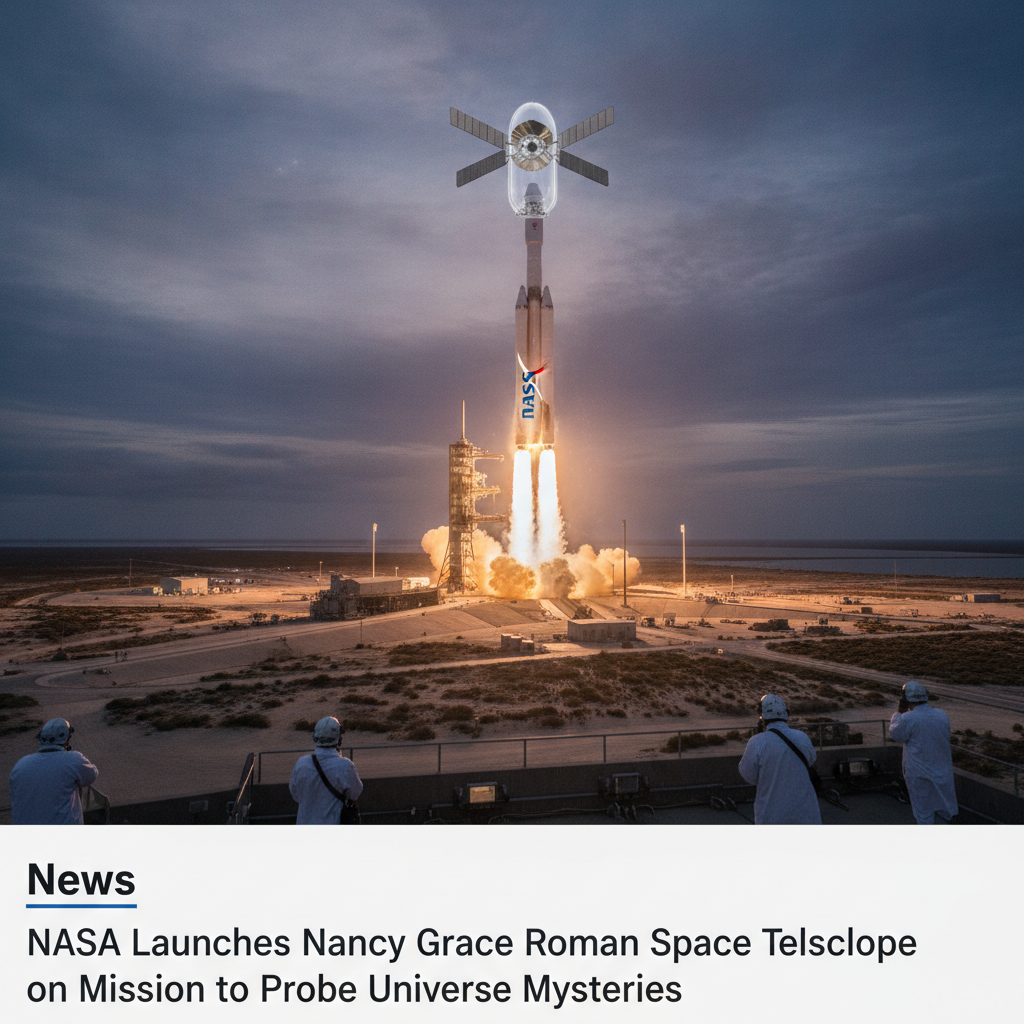
NASA sent its newest space observatory into orbit early Sunday from the Kennedy Space Center in Florida. The Nancy Grace Roman Space Telescope lifted off at 4:26 a.m. PT aboard a SpaceX Falcon Heavy rocket and is now traveling toward a distant observation point.
The spacecraft, roughly the size of a tour bus and weighing 18,000 pounds, will eventually settle at the second Sun-Earth Lagrange point known as L2. That location allows the telescope to maintain a stable position with limited fuel while offering a clear view of the sky.
Project manager Jackie Townsend described the event at a post-launch briefing, stating, "What a glorious dawn launch." NASA administrator Jared Isaacman added that initial telemetry showed all systems performing as expected after the solar panels and instruments began to deploy.
The telescope originated as a reconnaissance satellite before the National Reconnaissance Office transferred it to NASA. It carries the name of Nancy Grace Roman, the agency's first chief astronomer, who advocated for the Hubble Space Telescope. Its wide field of view will exceed that of Hubble by at least 100 times.
Scientists intend to use the instrument to trace the effects of dark matter on light across vast distances and to observe Type Ia supernovas in order to better understand dark energy. The telescope is also expected to detect more than 100,000 exoplanets through transit and microlensing methods.
Nicky Fox, NASA's associate administrator for the science mission directorate, noted at the briefing that the mission addresses the question of whether life exists elsewhere. She highlighted a coronagraph demonstration that could eventually image planets by blocking starlight.
The observatory will transmit 1.4 terabytes of data daily through a high-gain antenna, with the full archive made available via a cloud platform called Roman Nexus. Integration and test scientist Jeremy Perkins said the volume will surpass typical music streaming libraries and will allow broad public access to potential discoveries.
This report is based on coverage by LAist: https://laist.com/news/a-glorious-dawn-launch-nasas-newest-space-telescope-has-left-the-earth